1. Principles & Driver Conduct
TSR Ethos — Race Clean. Respect Others. Enjoy.
When in doubt, hold your line, brake normally and make your intentions clear. Do not make a sudden move simply to “help” another driver.
TSR exists to provide close, competitive and respectful endurance racing. Drivers are expected to use common sense and race with consideration for the cars around them.
Drivers must
- Race fairly and respectfully.
- Leave racing room when required.
- Accept that genuine mistakes happen.
- Follow simulation penalties and event instructions.
Drivers must not
- Deliberately cause contact.
- Retaliate for an incident.
- Use abusive or discriminatory language.
- Attempt to intimidate another competitor, On or Off Track
Drivers please make sure your Discord name is your real name or contains Part of your real name, this helps other drivers know who you are also helps the Broadcast Team,
2. Communication
In-game text chat
Text chat is not permitted during qualifying or after the race has started. Brief communication during grid waiting time is acceptable where the simulation permits it.
Drivers should remember that TSR races may be streamed. Keep all messages clean and appropriate.
Post-race
Drivers who have finished must wait until the session has ended before treating the server as a general chat room. Other competitors may still be racing.
3. Flags
🟨 Yellow Flag
Exercise caution and be prepared for a stopped, spinning or damaged car. Do not take unnecessary risks to gain a position.
🟦 Blue Flag
A faster car is approaching. The lapped car must remain predictable and must not defend against the lapping car.
⬜ White Flag
Expect a slow vehicle ahead. Take extra care around damaged or recovering cars.
⬛🟧 Black & Orange
Vehicle requires attention. Return to the pits safely for repairs where possible.
🟥 Red Flag
Where supported, the session is suspended. Follow the event administrator or simulation instructions.
4. Track Limits & Simulation Penalties
TSR allows the simulation to enforce normal track-limit warnings and penalties. Drivers are responsible for understanding the system used by Le Mans Ultimate or any other simulation specified for an event.
Drive-through penalties resulting from track limits, race starts or pit-stop infringements must be served within the period required by the simulation. TSR stewards will not normally clear an automatically issued drive-through.
Final laps: If a drive-through cannot be served before the chequered flag, the simulation's resulting time penalty will normally stand. No additional TSR penalty will normally be added for the same automatic infringement.
5. Multiclass Racing
Multiclass traffic is a shared responsibility. Faster cars must be patient and slower cars must be predictable.
Hypercar / LMP2
- You are responsible for selecting a safe passing opportunity.
- Do not expect a GT car to move off the racing line.
- Avoid forcing a slower car into an impossible situation.
- If the pass is not clearly on, wait.
LMGT3
- Continue on your normal racing line.
- Brake at your normal marker.
- Do not suddenly lift or change direction.
- Allow the faster car to complete the pass when safe.
6. Overtaking & Defending
Overtaking
The car behind has the primary responsibility for making a safe overtaking attempt.
Significant overlap is established when the front axle of the attacking car is alongside the driver's position of the car ahead before the corner's turn-in point.
Defending
- A driver may choose their preferred line when clear of the car behind.
- One defensive change of direction is permitted before the braking zone.
- Do not move under braking.
- When side-by-side, leave at least one car's width.
- Do not squeeze another car onto kerbs or beyond the circuit.
Good
Early, clear defensive move followed by a stable line into the corner.
Bad
Reactive weaving, moving under braking or closing the door after the attacking car has established overlap.
Divebombs
An attempt relying on excessive braking, unrealistic closing speed or contact to complete the pass may be penalised. A driver cannot manufacture corner ownership simply by arriving alongside after the other car has committed to the corner.
7. Blue Flags, Impeding & Unlapping
Qualifying
A driver on a valid hot lap has the right to complete that lap. The approaching driver should create sufficient space for their own lap. Drivers who are already off their competitive delta are encouraged to allow faster traffic through when practical.
Race
The lapped driver must not race or defend against the faster car. Drive predictably and facilitate the pass when safe.
The preferred method is to lift slightly on a straight or brake marginally earlier for a corner. Do not make a sudden move at the last second.
As a guideline, a lapped driver should normally provide a reasonable opportunity to pass within three opportunities. Persistent failure to do so may be considered impeding.
Unlapping
A lapped car may unlap itself where the opportunity is safe and the driver has the pace to pull clear. Once unlapped, the driver is no longer entitled to hold up the car behind simply because the positions have changed. If they cannot pull away, they should allow the faster car back through at the next safe opportunity.
8. Formation Lap, Starts & Full Course Yellow
Formation / Rolling Start
- Maintain formation and a predictable pace.
- No unnecessary weaving or brake checks.
- No overtaking before the race start signal.
- The lead car controls the formation pace within event instructions.
Lap One
Drivers should exercise additional caution during the opening lap. Cold tyres, heavy fuel loads and close traffic increase the consequences of aggressive moves. Serious avoidable first-lap incidents may receive enhanced penalties.
Full Course Yellow
When FCY is activated, immediately follow the speed and position instructions given by LMU. Do not use the neutralised period to gain an advantage, create unnecessary gaps or overtake where prohibited.
9. Pit Lane & Pit Exit
- Do not cross the pit exit line.
- Merge safely and predictably.
- Cars already on track should leave reasonable room for an exiting car.
- During practice and qualifying, exiting traffic must not unnecessarily interfere with a car on a hot lap.
- Indicators are not mandatory but may be useful when entering the pits.
10. Incidents, Damage & Rejoins
After a spin: hold the brakes. A stationary car is predictable. A car rolling unexpectedly across the circuit creates a second incident.
Safe Rejoin
- Check mirrors and relative position.
- Wait for a safe gap.
- Rejoin parallel to the circuit where possible.
- Remain off the racing line initially.
Unsafe Rejoin
- Driving directly into traffic.
- Crossing the racing line without checking.
- Forcing another driver to take avoiding action.
- Accelerating hard before the car is safely established.
Damaged Cars
A damaged car should return to the pits when it can no longer be driven safely at racing speed. Use hazard lights where available and stay away from the racing line where practical.
Off-track Advantage
If a driver gains a position or lasting advantage by leaving the circuit, the position should be returned at the earliest safe opportunity. This applies to both attacking and defending drivers. Leaving the circuit to avoid an incident may be considered an exception.
11. Stewarding & Penalties
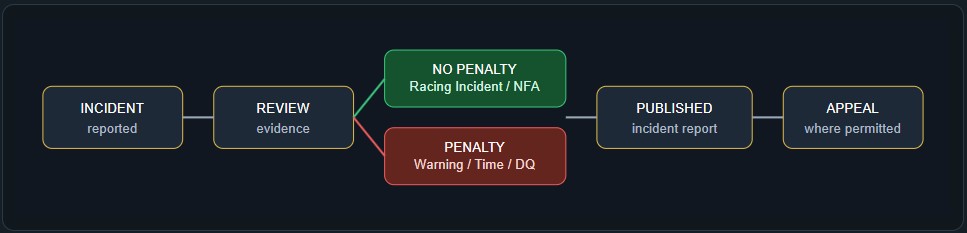
Reported incidents are reviewed by multiple TSR stewards where possible. The review considers the circumstances, driver actions, consequences and whether the incident was reasonably avoidable.
| Outcome |
Typical application |
| Racing Incident |
No driver is predominantly responsible. |
| NFA |
A driver was at fault, but they were the only driver meaningfully disadvantaged. |
| Warning |
Minor fault where the consequence does not justify a time penalty. |
| 5 seconds |
Minor contact, unfair advantage or failure to return a position where the consequence is limited. |
| 10 seconds |
Contact causing a spin, off-track excursion or significant time loss. |
| 15 seconds |
Collision causing damage and/or substantial position loss. |
| 30 seconds |
Severe incident, substantial damage or multiple-car collision. |
| DQ |
Deliberate contact, retaliation or serious misconduct. |
| Qualifying Ban |
Serious incidents where a race-time penalty is insufficient or ineffective. |
| Race Ban / Points |
Repeated or exceptionally serious conduct. Stewards may combine penalties where appropriate. |
Lap One
Lap one incidents will normally result in double penalties, also if a driver causes a multi car incident on lap one, this may result in further action from the Stewards.
Retaliation
Any deliberate on-track retaliation is prohibited. This includes post-race ramming. Serious retaliation may result in disqualification, a qualifying ban or a race ban.
Returning a Position
A driver who gains a position unfairly should return it at the earliest safe opportunity. Returning the position does not automatically remove liability, but it will be treated as a significant mitigating factor.